
USDT Betting Wallet Guide: Best Wallets for Tether Gambling in 2026
 Available in AU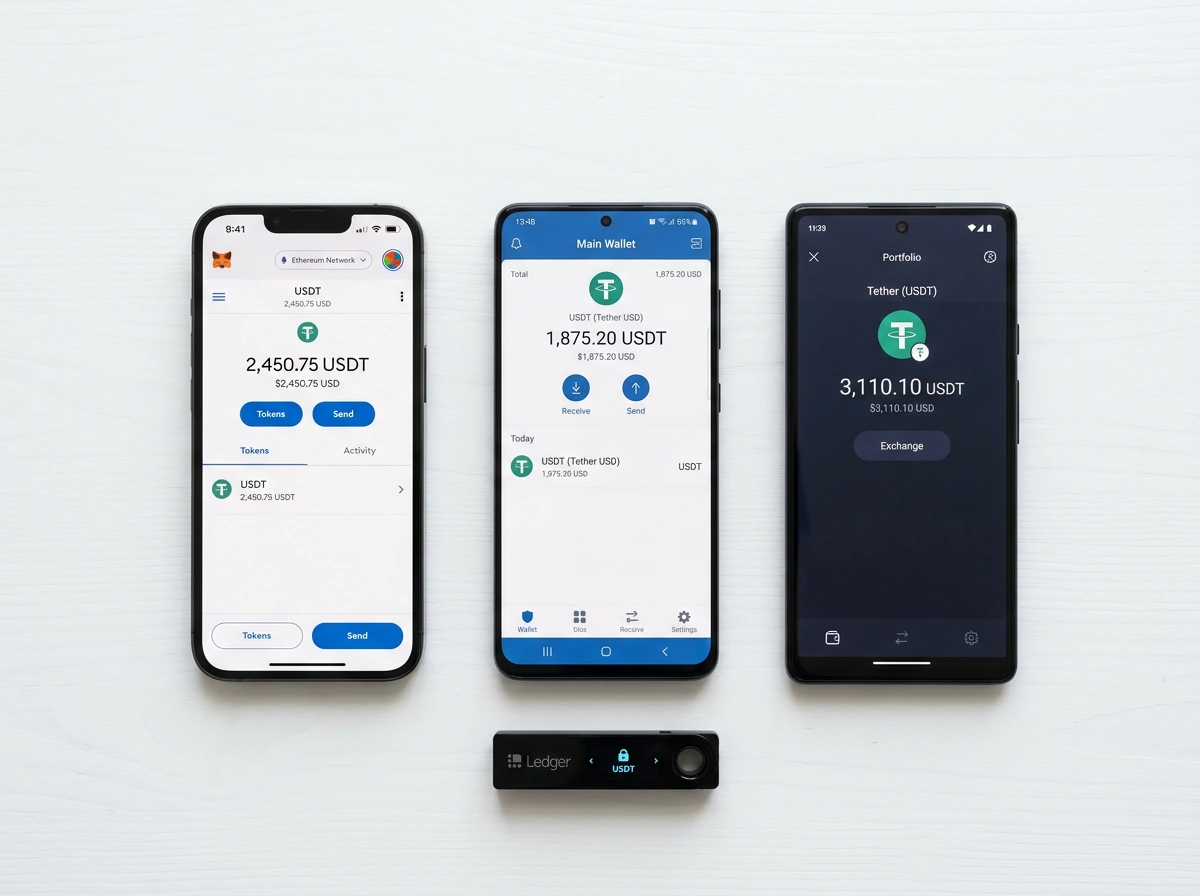
Your wallet is the only part of the USDT betting chain where you have complete sovereignty. The exchange is a third party. The sportsbook is a third party. The blockchain is a shared network. But your wallet — the private key, the seed phrase, the signing authority — belongs to you alone. Choosing the right wallet for betting is not a matter of brand preference. It is a decision about which tool best serves your specific transaction patterns, network preferences, and security requirements.
I have used every major wallet option for USDT betting over the past several years, and my recommendations are based on practical testing — hundreds of deposits, hundreds of withdrawals, across dozens of platforms. The wallet that works best for you depends on whether you prioritise TRC-20 speed, multi-chain flexibility, or hardware-level security.
TronLink vs MetaMask vs Trust Wallet for USDT Betting
USDT on the TRON network accounts for roughly $165.5 billion of total supply, compared to $102.7 billion on Ethereum. That distribution reflects where the stablecoin market has concentrated, and it influences which wallet makes the most sense for your betting activity.
TronLink is the native wallet for the TRON blockchain. If you are betting exclusively with TRC-20 USDT — which is the cheapest and fastest option for the vast majority of sportsbook transactions — TronLink is purpose-built for the job. It handles TRC-20 token management natively, integrates with the TRON energy and bandwidth system for fee optimisation, and provides a clean mobile app that makes deposit and withdrawal transactions straightforward. The limitation is scope: TronLink does not support Ethereum or Binance Smart Chain, so if you need to transact on those networks, you need a second wallet.
MetaMask is the default wallet for Ethereum and EVM-compatible chains, including Binance Smart Chain, Polygon, Arbitrum, and Base. If your USDT sits on Ethereum (ERC-20) or you use multiple EVM chains, MetaMask handles all of them from a single interface. Adding custom networks is simple, token management is mature, and the browser extension integrates with decentralised exchanges if you need to swap between assets. The drawback for USDT bettors is that MetaMask does not support TRON, which means you cannot send TRC-20 USDT from MetaMask. If TRC-20 is your primary network — and for fee reasons, it should be — MetaMask alone is insufficient.
Trust Wallet is the multi-chain option that covers TRC-20, ERC-20, BEP-20, and dozens of other networks from a single app. For a bettor who uses multiple sportsbooks across different networks, Trust Wallet eliminates the need for separate wallet apps. It handles USDT on TRON, Ethereum, and BSC equally well, supports hardware wallet integration (via WalletConnect), and provides a built-in token swap function. The interface is less specialised than TronLink for TRON-specific features (energy management is not as intuitive), but the breadth of network support makes it the most versatile option for USDT bettors.
My setup: TronLink as my primary wallet for TRC-20 USDT deposits and withdrawals (which account for roughly 90% of my sportsbook transactions), and Trust Wallet as a secondary wallet for the occasional platform that requires ERC-20 or BEP-20. This dual-wallet approach gives me optimised performance on my primary network and coverage across all others.
Setting Up a Wallet for Tether Gambling
The total number of on-chain USDT wallets has grown to 139.1 million, representing 70.7% of all stablecoin wallets globally. Setting up your own takes under five minutes, and the process is nearly identical across TronLink, MetaMask, and Trust Wallet.
Download the wallet app from the official source. For TronLink, use the App Store or Google Play Store listing linked from tronlink.org. For MetaMask, use metamask.io. For Trust Wallet, use trustwallet.com. Never download wallet apps from third-party sources or unofficial links — fake wallet apps designed to steal your seed phrase are a documented attack vector.
Create a new wallet. The app generates a seed phrase — 12 or 24 words that are the master key to your wallet. Write this phrase down on paper immediately. Do not screenshot it, do not save it in a notes app, do not email it to yourself. The seed phrase is the single most critical piece of security in your entire USDT betting setup. Anyone who has it can access your funds from any device.
Verify the seed phrase by entering the words in the order the app requests. This step confirms you have recorded the phrase correctly. Store the paper copy in a secure location — a safe, a lockbox, or a sealed envelope in a place only you can access.
For TronLink, your wallet is immediately ready to receive TRC-20 USDT. For MetaMask, ensure you are on the correct network (Ethereum mainnet for ERC-20, or add BSC/Polygon manually for other networks). For Trust Wallet, navigate to the token list and enable USDT on the networks you plan to use.
Fund the wallet with a small amount of the native network token to cover transaction fees. TronLink needs TRX (10 to 50 TRX is sufficient to start). MetaMask on Ethereum needs ETH (0.01 to 0.05 ETH covers several transactions). Trust Wallet needs the relevant native token for whichever network you are transacting on. Without these gas tokens, you can receive USDT but you cannot send it.
Wallet Security Best Practices for Bettors
Security for a betting wallet is not fundamentally different from security for any crypto wallet — but the patterns of use are different, which creates specific vulnerabilities worth addressing.
Betting wallets transact frequently. Every deposit and withdrawal involves interacting with the wallet app, copying and pasting addresses, and confirming transactions. This frequency increases your exposure to clipboard-hijacking malware, shoulder-surfing, and accidental sends. The countermeasure is habit: verify the first and last five characters of every address you paste, every time, without exception. Make it automatic. Make it non-negotiable.
Betting wallets hold rotating balances. Unlike a savings wallet that you fund once and leave alone, a betting wallet sees money flowing in and out regularly. This means the wallet’s security is tested continuously — each interaction is an opportunity for an error or an attack. Use biometric authentication (fingerprint or Face ID) to lock your wallet app, set a transaction confirmation PIN that differs from your phone unlock code, and never leave the wallet app open in the background after completing a transaction.
Separate your betting wallet from your savings wallet. If you hold significant USDT outside of your betting activity — as a savings vehicle, for trading, or as part of a broader crypto portfolio — keep those funds in a different wallet (ideally a hardware wallet). Your betting wallet should hold only the USDT you are actively wagering with. If the betting wallet is compromised, your broader holdings remain protected.
Back up your seed phrase in two physical locations. A single copy in one location is vulnerable to fire, flood, theft, or simple misplacement. Two copies in separate secure locations provide redundancy. Some bettors use metal seed phrase storage (stamped steel plates) for durability — paper can be destroyed by water or fire, metal survives both. For a complete assessment of the security landscape beyond wallet management, the step-by-step betting guide covers the full transaction chain from exchange to sportsbook and back.
Choosing Based on How You Actually Bet
The best wallet is the one that matches your actual usage pattern, not the one with the most features or the strongest marketing.
If you bet at one or two sportsbooks, always use TRC-20, and value speed and simplicity: TronLink. It does one thing extremely well, and that one thing is the most common USDT betting transaction.
If you bet across multiple platforms on different networks and want a single app for everything: Trust Wallet. The trade-off is that no single network’s features are as deeply integrated as they are in a dedicated wallet, but the convenience of managing all your USDT from one interface is significant for multi-platform bettors.
If your USDT is primarily on Ethereum or EVM chains and you also interact with DeFi protocols: MetaMask. Its EVM integration is unmatched, and the browser extension is invaluable for web-based interactions. Just accept that you will need a separate solution for TRC-20 transactions.
If you hold large USDT balances and security is your primary concern: a hardware wallet (Ledger or Trezor) paired with a software wallet for daily transactions. The hardware wallet stores your private keys offline, immune to remote attacks. You transfer USDT from the hardware wallet to your hot wallet (TronLink or Trust Wallet) in session-sized amounts, and use the hot wallet for sportsbook deposits. This layered approach provides the strongest security posture available for USDT betting.
Can I use a hardware wallet for USDT betting deposits?
Yes, but with a workflow adjustment. Hardware wallets like Ledger and Trezor support USDT on Ethereum and some other networks, but direct USDT deposits to sportsbooks from a hardware wallet are slower because each transaction requires physical confirmation on the device. Most bettors use a hardware wallet as a vault for their main USDT reserve and transfer session-sized amounts to a hot wallet (TronLink, MetaMask, or Trust Wallet) for the actual deposit. This adds one extra transfer step but provides hardware-level security for your primary holdings.
Which wallet supports the most blockchain networks for Tether?
Trust Wallet supports the broadest range of networks for USDT, including TRC-20, ERC-20, BEP-20, Polygon, Arbitrum, Solana, and others. MetaMask supports all EVM-compatible networks (Ethereum, BSC, Polygon, Arbitrum, Base) but not TRON. TronLink supports only the TRON network. For maximum network flexibility with a single wallet, Trust Wallet is the most versatile option available in 2026.
The full picture is in the Tether betting guide.
Which network to use: TRC-20 vs ERC-20.