
How to Bet With Tether: Step-by-Step USDT Wagering Guide
 Available in AU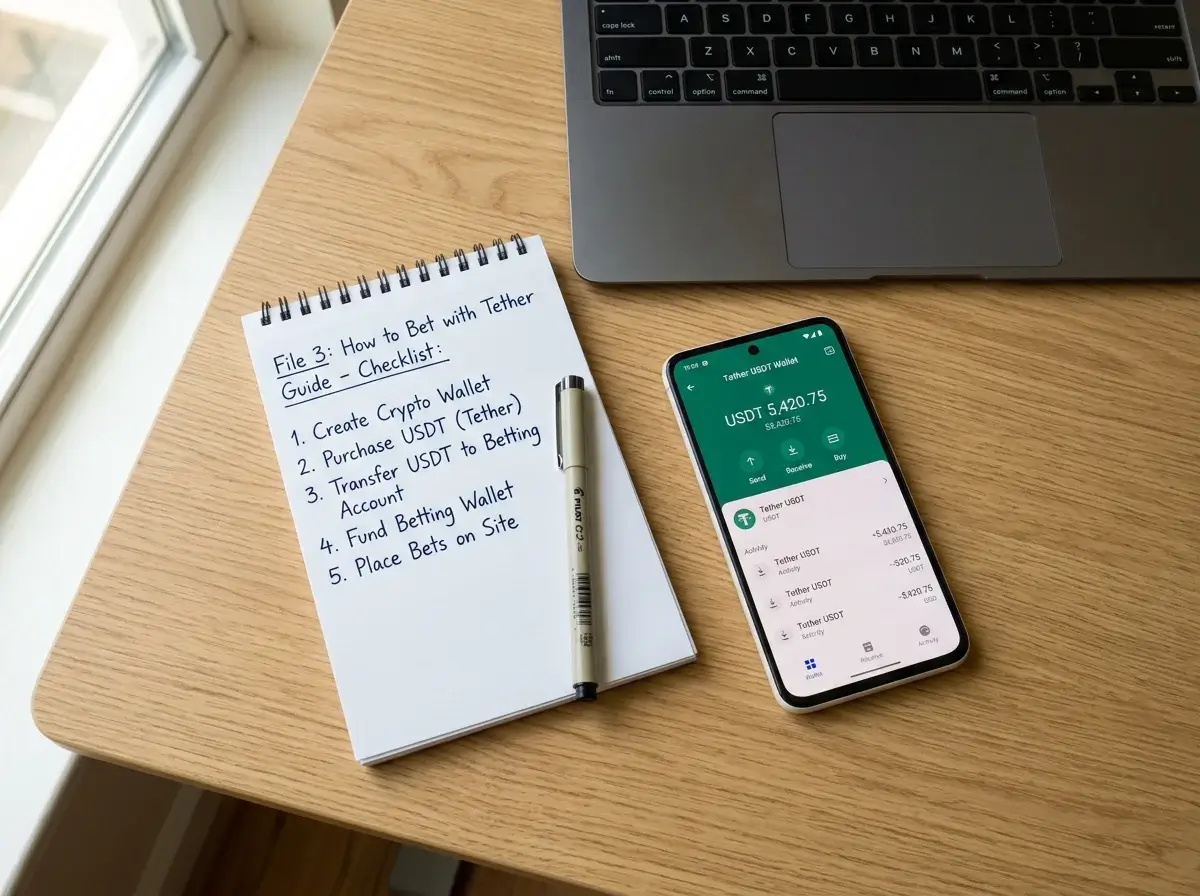
The entire process — from opening an exchange account to placing your first USDT bet — took me under twenty minutes the first time I did it. That was back in 2019, when the infrastructure was clunkier and fewer Australian exchanges supported Tether directly. Today it is faster, but the number of decision points along the way has actually increased. Which exchange? Which network? Which wallet? Each choice has consequences for your fees, your speed, and your security.
This guide walks you through the complete cycle: buying USDT with Australian dollars, setting up a wallet, depositing at a sportsbook or casino, placing a bet, and withdrawing your winnings back to AUD. I have structured it as the tutorial I wish someone had given me before my first deposit, covering not just the “how” but the “why” behind each step. If you have never touched cryptocurrency before, you will be able to follow along. If you have crypto experience but have not used USDT for betting specifically, skip to the sections that matter to you.
One thing upfront: this is a linear process with a clear sequence. Skipping steps — sending USDT directly from an exchange to a betting site without an intermediate wallet, for example — is technically possible at some platforms but introduces risks I will explain as we go. The full cycle takes a bit more time the first time through, but once your accounts and wallet are set up, subsequent deposits take about two minutes from start to finish.
Buying USDT in Australia With AUD
Before you can bet with Tether, you need to own some. For Australians, that means converting AUD to USDT through a local cryptocurrency exchange. The process is simple enough, but the exchange you choose affects your fees, your verification timeline, and which USDT networks you can withdraw to.
Australian exchanges like CoinSpot, Swyftx, and the local arm of Binance all support USDT purchases with AUD. Each has different fee structures, deposit methods, and identity verification requirements. Most accept PayID or bank transfer for AUD deposits, and verification typically takes between a few hours and one business day for new accounts, though some offer expedited checks that clear within minutes if your ID documents are in order.
The key decision at the exchange level is which USDT network to withdraw to. When you buy USDT, the tokens exist on the exchange’s internal ledger. To move them to your wallet — and then to a betting site — you need to select a blockchain network for the withdrawal. TRC-20, ERC-20, and BEP-20 are the main options, and your choice here determines your transaction fees and speed. I cover the mechanics of this choice in the wallet section below, but the critical point is: make the network decision before you buy, not after.
The number of USDT wallets globally has reached 139.1 million, accounting for over 70% of all stablecoin wallets. That infrastructure depth means the on-ramp from AUD to USDT is well-trodden, and the process is no more complicated than buying shares through an online broker. The exchange comparison and fee breakdowns deserve their own guide, but the summary here covers what you need to get started.
Setting Up a Wallet for Tether Betting
I have a friend who lost 800 USDT because he sent tokens from his exchange directly to a sportsbook that only supported TRC-20, using an ERC-20 withdrawal. The tokens vanished into an address that existed on a different blockchain. No recovery, no refund. That story is why I insist on an intermediate wallet step, even though it adds a minute to the process.
A personal crypto wallet sits between your exchange and your betting site. It gives you control over your tokens, lets you verify the network before sending, and keeps your exchange account separated from your gambling activity — which matters for record-keeping and, potentially, for your exchange’s terms of service.
Your wallet choice should match the network you plan to use. The numbers make the case: USDT issued on TRON totals roughly $165.5 billion in circulation, compared to $102.7 billion on Ethereum. That volume reflects real usage patterns — TRON is where most USDT activity happens, including gambling transactions, because of its lower fees and faster confirmations.
For TRC-20 USDT, TronLink is the purpose-built option. It is available as a browser extension and mobile app, connects directly to the TRON blockchain, and handles TRC-20 tokens natively. Setup takes about three minutes: install the extension, create a wallet, write down your twelve-word seed phrase, and you are operational. That seed phrase is the master key to your wallet — anyone who has it controls your funds. Store it offline, on paper, in a secure location. Not in a screenshot. Not in a note on your phone.
For ERC-20 USDT, MetaMask is the standard. It has been around since 2016, has the largest user base of any Ethereum wallet, and integrates with virtually every platform that accepts ERC-20 tokens. The setup process mirrors TronLink: install, create, record your seed phrase. MetaMask can also be configured to support other EVM-compatible networks, including BNB Chain for BEP-20 USDT, making it a versatile option if you want to keep your options open.
Trust Wallet offers a multi-chain approach — it supports TRC-20, ERC-20, and BEP-20 from a single mobile interface. The trade-off is that managing multiple networks in one wallet can be confusing for newcomers. If you know which network you will use and want the simplest experience, a single-network wallet like TronLink or MetaMask is cleaner. If you want flexibility, Trust Wallet covers more ground.
Regardless of which wallet you choose, the setup checklist is the same. Install from the official source — the official website or official app store listing, not a link from a search ad or a forum post. Create a new wallet, not import. Record your seed phrase on physical paper, not digitally. Verify the wallet address by sending a tiny test amount from your exchange — 1 USDT is enough — and confirming it arrives before transferring your actual bankroll. This test costs less than a dollar on TRC-20 and could save you hundreds if something is misconfigured.
Making Your First USDT Deposit
Your wallet is funded, your sportsbook account is created, and now you are staring at a deposit page with a long string of characters and a QR code. This is the moment where attention to detail matters most, because blockchain transactions are irreversible.
The CryptoManiaks editorial team has described Tether as the most efficient tool for modern sports betting, combining blockchain speed with dollar stability. That efficiency is real — once you have done this once, subsequent deposits take under two minutes. But the first time requires care.
Step one: navigate to the deposit section of your sportsbook and select USDT as your currency. The platform will ask you to choose a network — TRC-20, ERC-20, or in some cases BEP-20. Select the same network your wallet uses. I cannot stress this enough. If your wallet holds TRC-20 USDT and you select ERC-20 on the sportsbook’s deposit page, the address generated will be an Ethereum address, and sending TRC-20 tokens to it will result in permanent loss.
Step two: copy the deposit address. Use the copy button provided by the platform, not manual selection. Deposit addresses are long — typically 34 characters for TRON, 42 for Ethereum — and a single wrong character sends your funds to a nonexistent or someone else’s wallet. Some platforms also display a QR code, which eliminates copy-paste errors if you are depositing from a mobile wallet.
Step three: open your wallet, initiate a transfer, and paste the deposit address. Enter the amount you want to deposit. Your wallet will display the estimated network fee before you confirm. On TRC-20, expect fees in the range of $0.81 to $8.45, depending on your wallet’s energy balance and network conditions. If the fee looks abnormally high, check whether the network is congested — waiting ten or fifteen minutes can sometimes reduce the cost.
Step four: confirm the transaction in your wallet. You will see a transaction hash — a unique identifier for your transfer. Keep this. If there is any delay in your deposit crediting, the transaction hash is what support will need to trace your funds.
Step five: wait for confirmation. TRC-20 deposits typically confirm within 30 to 60 seconds. ERC-20 can take three to five minutes. Some sportsbooks credit your balance after a single network confirmation, others wait for multiple confirmations. Once credited, your USDT balance appears in your sportsbook account, and you are ready to bet.
A practical tip from years of doing this: do not deposit your entire bankroll in one transfer on your first use of a new platform. Send a small test amount — 10 or 20 USDT — and confirm it arrives and displays correctly in your account. Then verify that you can navigate the betting interface, see your balance, and access the withdrawal page. Only after that test should you transfer your intended playing amount. The cost of the extra network fee on a test transaction is trivial compared to the cost of discovering a problem after depositing 500 USDT.
Placing Your First Bet With USDT
Here is where first-time USDT bettors often get confused: your balance says USDT, the odds are displayed in decimal format, but what does a “100 USDT bet at 2.50 odds” actually mean in practical terms?
USDT is pegged to the US dollar, so 1 USDT is effectively $1 USD. When you place a 100 USDT bet at decimal odds of 2.50, your potential return is 250 USDT — your 100 USDT stake plus 150 USDT in profit. The math works exactly like betting with US dollars, which is one of the reasons punters have been migrating from Bitcoin to stablecoins. With BTC, a winning bet might be worth more or less in fiat terms by the time you withdraw, depending on price movements during the settlement period. With USDT, 150 USDT profit today is still worth approximately $150 USD tomorrow.
Most USDT sportsbooks display odds in decimal format by default, which suits Australian punters who are already familiar with decimal odds from domestic bookmakers. Some platforms offer the option to switch between decimal, fractional, and American formats in your account settings. If you are used to seeing $2.50 at a local bookie, the same event at a USDT sportsbook shows as 2.50 — identical format, identical meaning, just denominated in USDT instead of AUD.
Bet placement itself works identically to any online sportsbook. Select a market, click the odds, enter your stake in USDT, and confirm. Your balance deducts immediately. If you are placing a multi or accumulator, the process is the same — add selections to your bet slip, enter your total stake, and review the combined odds before confirming.
One difference you might notice: some USDT sportsbooks display minimum and maximum bet limits that differ from what you would see at a fiat bookmaker. Minimum bets are often lower — 0.10 USDT or even 0.01 USDT at some platforms — which makes them accessible for testing strategies with minimal risk. Maximum bet limits vary by market and by sport. High-profile events like an AFL Grand Final or an EPL derby typically allow higher maximum stakes than a mid-week reserve-grade match.
Live or in-play betting with USDT works the same as with any currency, with one caveat: odds update in real time, and your bet is placed at the odds displayed when the sportsbook’s server receives your request, not when you click the button. On a fast-moving live market, there can be a difference. Most platforms will reject a bet if the odds have moved beyond a threshold since you clicked, giving you the option to accept the new odds or cancel.
Settlement happens automatically. When your bet wins, the payout credits to your USDT balance within seconds of the event result being confirmed. For pre-match bets, this is typically immediate after the final whistle. For live bets, settlement is equally fast. Your updated balance reflects both your returned stake and your profit, and from there you can place another bet or initiate a withdrawal.
A note on currency perception: because USDT is pegged to USD and not AUD, your effective stake in Australian dollar terms depends on the USD/AUD exchange rate. If the Aussie dollar is sitting at 0.65 against the greenback, a 100 USDT bet costs you roughly 154 AUD. That conversion happens when you buy and sell USDT, not within the sportsbook itself, but it is worth keeping in mind when you are sizing your bets relative to your AUD bankroll. A 100 USDT bet might feel like a 100-dollar bet, but in your home currency it is closer to 150.
Withdrawing Winnings Back to AUD
Winning is the fun part. Getting your winnings out of a sportsbook and back into Australian dollars involves a reverse path that I have done enough times to navigate in my sleep, but the first trip through has a couple of moments that trip people up.
The withdrawal path runs: sportsbook to your personal wallet to your Australian exchange to your bank account. Each step is manageable on its own, but the ATO treats each conversion as a potential taxable event, which is why I mention it here rather than waiting until you file your return and discover the obligations retroactively.
Start at the sportsbook’s withdrawal page. Select USDT, choose the network that matches your wallet, and enter your wallet address. As with deposits, use the copy-paste function rather than typing the address manually. Enter the amount you want to withdraw. Some platforms impose minimum withdrawal amounts — typically 10 to 20 USDT — and may charge a small withdrawal fee on top of the network cost. Review and confirm.
Processing time is the variable you cannot control. The blockchain side is fast — TRC-20 delivers in under a minute once the platform releases the tokens. But the platform’s internal processing can take anywhere from fifteen minutes to several days, depending on the sportsbook, your verification level, and the withdrawal amount. In my experience, established platforms with verified accounts process withdrawals within two to four hours during business hours.
Once the USDT arrives in your personal wallet, you can hold it there or move it to your Australian exchange for conversion to AUD. Sending USDT from your wallet to the exchange follows the same process as any other transfer — select the network, paste the exchange’s deposit address, confirm, and wait for the tokens to credit.
At the exchange, you sell USDT for AUD. The exchange rate will be very close to the USD/AUD rate, with a small spread that represents the exchange’s fee. Once the sale is complete, you can withdraw AUD to your bank account. Most Australian exchanges process AUD withdrawals via PayID — which settles in seconds — or bank transfer, which takes one to two business days.
The ATO considers USDT a capital gains tax asset, not foreign currency. Every disposal of USDT — including selling it for AUD on an exchange — is a taxable event. The gain or loss is calculated as the difference between the AUD value when you acquired the USDT and the AUD value when you sold it. If you bought USDT at $1.52 AUD and sold it at $1.55 AUD, the $0.03 per token difference is a capital gain. For most recreational bettors, the gain on the USDT itself (as opposed to the betting winnings) is small, but it is your obligation to track it. Keep records of every transaction — purchase, deposit, withdrawal, sale — with dates and AUD values. Choosing the right network can also minimise the fees that eat into your final AUD amount.
USDT Betting Process FAQ
How long does it take to buy USDT and deposit it at a sportsbook?
If your exchange account is already verified, the entire process takes about five to ten minutes. Buying USDT on an Australian exchange is near-instant once your AUD deposit clears. Transferring USDT from the exchange to your wallet takes one to three minutes on TRC-20. Depositing from your wallet to the sportsbook adds another one to five minutes depending on the platform’s confirmation requirements. The bottleneck for first-time users is exchange verification, which can take a few hours to one business day.
Can I send USDT directly from an exchange to a betting site?
Technically yes — most exchanges allow you to withdraw USDT to any compatible address, including a sportsbook’s deposit address. However, I recommend using a personal wallet as an intermediate step. Some exchanges monitor withdrawal addresses and may flag or restrict accounts that send funds to gambling platforms. An intermediate wallet also gives you a chance to verify the network and amount before the final transfer, reducing the risk of costly errors.
Do I need to verify my identity before making a USDT deposit?
It depends on the platform. Some USDT sportsbooks allow deposits and play without identity verification up to a certain threshold — often around 2,000 USDT in cumulative deposits. Above that threshold, most platforms require KYC documentation including a photo ID and proof of address. A few platforms require full KYC before any deposit. Check the platform’s verification policy before you transfer funds, because discovering a KYC requirement after your USDT is already in the sportsbook’s wallet can mean delays in accessing your balance.
Is there a way to convert USDT winnings to AUD without a crypto exchange?
Peer-to-peer platforms exist where you can sell USDT directly to another person for AUD via bank transfer, but these carry higher counterparty risk and are less regulated than established exchanges. For most Australian punters, selling USDT through a local exchange like CoinSpot or Swyftx remains the safest and most straightforward path to AUD. The exchange handles the conversion, and you withdraw AUD directly to your bank account.
The full picture is in the Tether betting guide.
Where to buy the coins first: buy USDT in Australia.