
TRC-20 vs ERC-20 for Tether Betting: Fees, Speed, and Compatibility
 Available in AU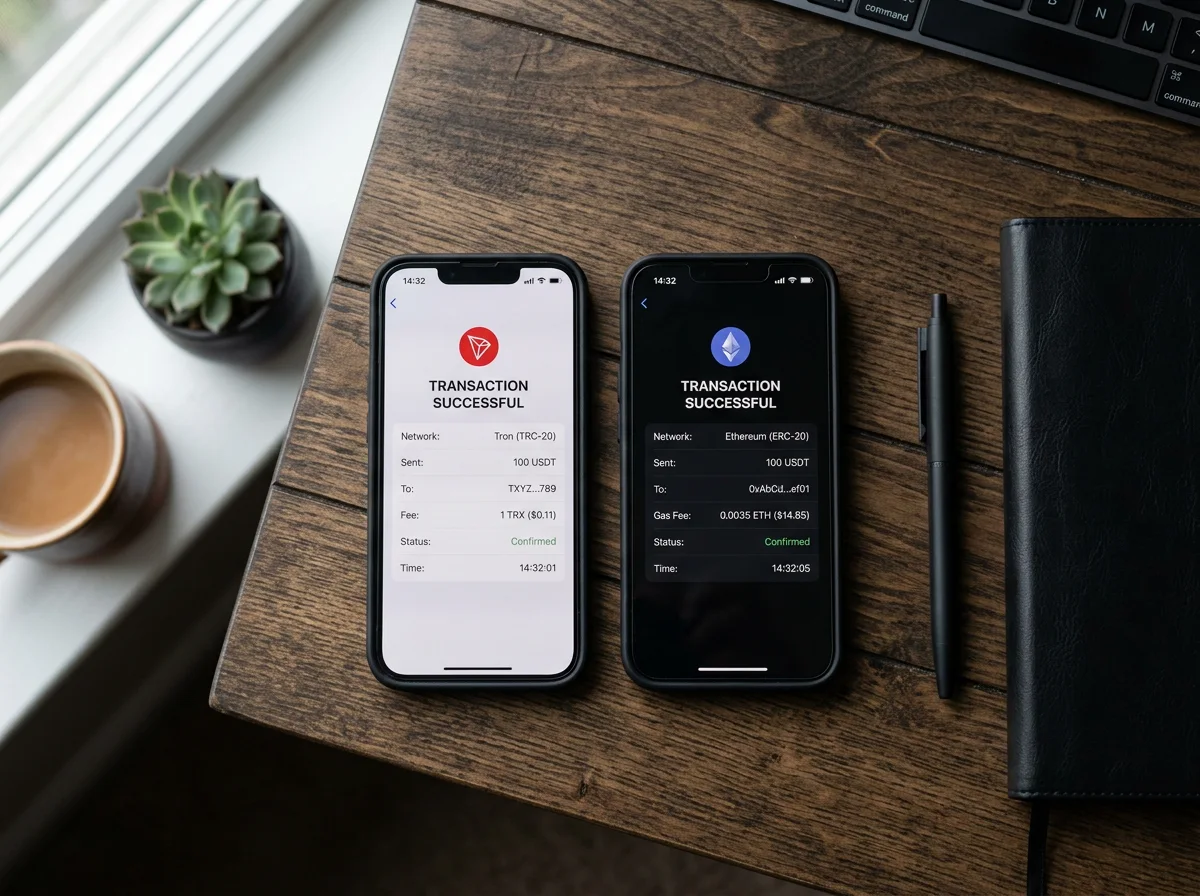
I sent my first USDT deposit to a sportsbook on ERC-20 in 2019 and paid more in gas fees than I wagered on my opening bet. That expensive lesson taught me something the crypto betting industry has since confirmed at scale: the network you choose for your Tether transactions is not a technical footnote – it is a cost centre that compounds with every deposit and withdrawal you make.
Roughly $165.5 billion in USDT sits on the TRON network versus $102.7 billion on Ethereum, and that imbalance exists for a reason. The market has voted with its wallets, and the winning network is the one that moves stablecoins cheaply. But “cheaper” does not always mean “better for betting,” and the trade-offs between TRC-20, ERC-20, and BEP-20 matter more than a simple fee comparison suggests.
Real Fee Comparison: TRC-20 vs ERC-20 for Bettors
Max Krupyshev, who runs one of the largest crypto payment processors in the iGaming space, has pointed out that crypto transaction fees can run almost three times lower than traditional fiat gateways. That advantage concentrates heavily on TRC-20 – and it is worth understanding exactly why.
A TRC-20 USDT transfer costs between $0.81 and $8.45 depending on your wallet’s energy balance and the current state of the TRON network’s resource model. TRON uses a bandwidth and energy system rather than a simple gas fee, which means your costs vary based on how your wallet is configured. A wallet that has staked TRX for energy can send USDT for under a dollar. A fresh wallet with no staked energy pays the higher end of that range. For a bettor making regular deposits and withdrawals, staking a small amount of TRX for energy pays for itself within a few transactions.
ERC-20 USDT transfers are priced in Ethereum gas, which fluctuates with network demand. During quiet periods, a simple token transfer might cost $2 to $5. During high-traffic periods – a major DeFi event, an NFT launch, a market crash driving on-chain activity – the same transfer can spike to $20, $50, or more. I have seen gas fees exceed $100 during extreme congestion events. For a bettor depositing 200 USDT, paying $50 in fees is a 25% tax on your bankroll before you place a single wager.
BEP-20 on Binance Smart Chain sits between the two, typically costing $0.05 to $0.30 per transfer. The fees are the lowest of the three networks, but BEP-20 support at crypto sportsbooks is less universal than TRC-20 or ERC-20, which limits its practical utility for bettors. If your preferred platform supports it, BEP-20 is the cheapest option. If it does not, TRC-20 is the clear default.
Over a year of regular betting activity – say, 4 deposits and 4 withdrawals per month – the fee difference compounds dramatically. Eight monthly transactions at $1 on TRC-20 cost $96 per year. The same eight transactions at $10 on ERC-20 during moderate congestion cost $960. That is $864 in savings that goes directly to your bankroll, not to miners or validators.
Confirmation Times and Deposit Speed
When a sportsbook shows “pending” on your deposit, you are waiting for the blockchain to confirm the transaction before the funds credit to your account. How long that takes depends entirely on your network choice.
TRON produces a block every 3 seconds. Most sportsbooks require between 1 and 20 confirmations for a TRC-20 deposit, which means your funds arrive in 3 seconds to 1 minute. In practice, I see most TRC-20 deposits credited within 30 seconds. For in-play betting where you want to fund your account and place a wager before odds shift, that speed matters.
Ethereum produces a block every 12 seconds post-merge. Twenty confirmations take about 4 minutes under normal conditions. That is not slow by any reasonable standard, but it is measurably slower than TRON – and during network congestion, your transaction can sit in the mempool for minutes or hours before being included in a block at all. If you set your gas price too low during a busy period, the transaction might not confirm until congestion clears.
BEP-20 on Binance Smart Chain produces blocks every 3 seconds, matching TRON’s speed. Confirmation times are effectively identical to TRC-20, making it equally suitable for time-sensitive deposits.
For pre-match betting, the difference between 30 seconds and 4 minutes is irrelevant. For live betting – where you spot value in shifting odds and need to fund your account fast – TRC-20 and BEP-20 give you a meaningful edge. I cover the implications for real-time wagering in the withdrawal speed guide, where the same confirmation dynamics apply in reverse.
Which Betting Platforms Support Which Networks
I tested seventeen crypto sportsbooks for network support in early 2026, and the results were uneven enough to warrant checking before you commit to any platform.
TRC-20 support is effectively universal. Every crypto sportsbook I tested accepts TRC-20 USDT deposits and processes withdrawals on the same network. It has become the default standard for stablecoin transactions in the iGaming industry, which is consistent with its dominance in the broader USDT ecosystem.
ERC-20 support is nearly as widespread but comes with caveats. Most platforms accept ERC-20 deposits, but some set higher minimum deposit thresholds on Ethereum to account for the gas costs – a platform might accept a 10 USDT deposit on TRC-20 but require a 50 USDT minimum on ERC-20. Withdrawal minimums follow the same pattern. If you hold your USDT on Ethereum and do not want to bridge to TRON, confirm the minimums at your chosen sportsbook before assuming your deposit amount qualifies.
BEP-20 support is the most variable. Roughly half of the platforms I tested accept BEP-20 USDT, and support tends to correlate with whether the platform also accepts BNB or other Binance Smart Chain tokens. If BEP-20 is important to you – and the fee savings make it appealing – verify support before you register. Sending BEP-20 USDT to a platform that only supports TRC-20 or ERC-20 will result in lost funds.
That last point deserves emphasis. USDT is the same stablecoin across all three networks, but the tokens are not interchangeable at the address level. Sending TRC-20 USDT to an ERC-20 deposit address – or any other network mismatch – means your funds are gone. There is no reversal mechanism on the blockchain, and the sportsbook cannot recover tokens sent on the wrong network. Always triple-check the network before confirming a deposit. This is the single most expensive mistake a USDT bettor can make, and I have seen it happen to experienced crypto users who were moving too fast.
Choosing Your Network as an Australian Bettor
For most Australian punters, the decision is straightforward. TRC-20 is the default choice – lowest fees among widely supported networks, fastest confirmations, and universal acceptance at crypto sportsbooks. If you are buying USDT on an Australian exchange like CoinSpot or Swyftx, both support TRC-20 withdrawals, so you can move your USDT from exchange to sportsbook without bridging between networks.
Use ERC-20 if your USDT is already on Ethereum and bridging to TRON would cost more than the fee savings justify. For a single deposit of a large amount, the per-transaction fee difference may not matter enough to warrant the extra step. For regular depositors making multiple transactions per month, the switch to TRC-20 pays for itself almost immediately.
Use BEP-20 if your platform supports it and you are comfortable with the reduced universality. The fees are the lowest available, and the speed matches TRC-20. The trade-off is that your next platform might not support it, which would force a network switch or a bridge transaction.
Can I switch networks after choosing one for my first deposit?
Yes. Your choice of network for one deposit does not lock you into that network for future transactions. Each deposit and withdrawal is an independent blockchain transaction, and you can switch between TRC-20, ERC-20, and BEP-20 freely, provided the platform supports the network you want to use. Just ensure you select the correct network each time and match it to the deposit address the platform generates.
What happens if I send TRC-20 USDT to an ERC-20 address?
The tokens will be lost. Blockchain networks are separate systems, and an address on one network cannot receive tokens from another. There is no way to reverse the transaction or recover the funds once sent. Always verify that the network selected in your wallet matches the network displayed on the sportsbook’s deposit page before confirming any transfer.
Does BEP-20 offer any advantage over TRC-20 for betting?
BEP-20 transfer fees are slightly lower than TRC-20 in most conditions – often under $0.30 per transaction compared to $0.81 or more on TRC-20. Confirmation speed is comparable. The disadvantage is that fewer crypto sportsbooks support BEP-20, so you may find your platform options limited. If your preferred sportsbook accepts BEP-20, it is a viable and cost-effective choice.
The full picture is in the Tether betting guide.
What the networks cost you: USDT transaction fees.