Provably Fair Tether Games: How Blockchain Verification Works in USDT Casinos
 Available in AU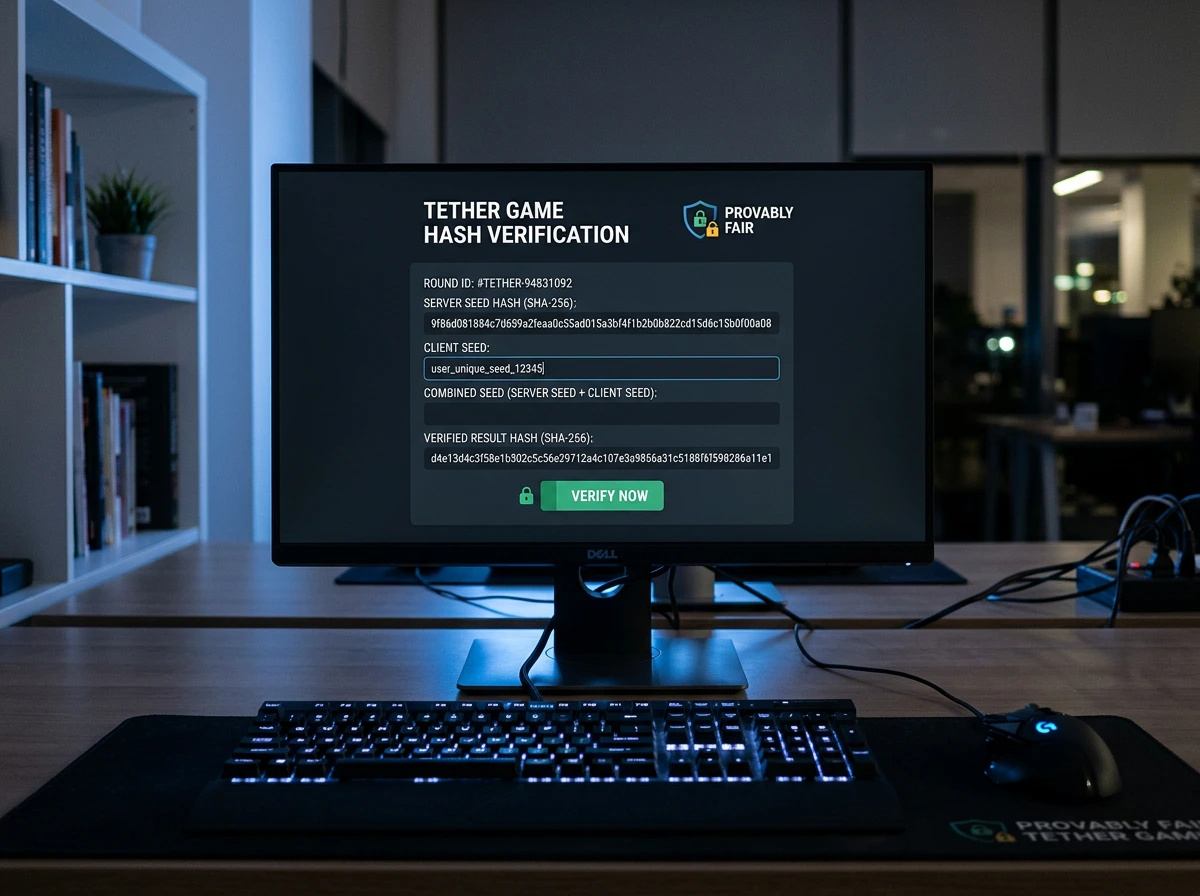
Every casino in history has asked you to trust that the games are fair. Provably fair technology is the first system that lets you verify instead. I remember the first time I checked a hash against a game result at a USDT casino – it felt like opening the hood of a car you had been driving blindfolded. The engine was there, it was running, and for the first time I could see exactly how it worked.
Crypto gambling hit $26 billion in bets during Q1 2025 alone – nearly double the same period the year before. That money is flowing into an ecosystem where trust is the primary currency, and provably fair is the mechanism that earns it. As SOFTSWISS Chief Operating Officer Vitali Matsukevich has observed, the benefits of digital currencies like fast transactions and anonymity still attract many players, and the trust layer that provably fair adds on top makes the proposition considerably stronger.
The Mechanics Behind Provably Fair USDT Games
Provably fair is not a brand name or a certification – it is a cryptographic protocol. The mechanics are elegant once you strip away the jargon, and understanding them takes about five minutes.
Before each game round begins, the casino generates a server seed – a random string of characters – and hashes it using a one-way cryptographic function like SHA-256. The hash is shared with you before the round starts. This is important: the hash is a fingerprint of the server seed, but it does not reveal the seed itself. You can see the fingerprint, but you cannot reverse-engineer the seed from it. This proves that the casino committed to the outcome before you placed your bet.
You also provide a client seed, either automatically generated by your browser or manually entered by you. Some systems add a nonce – a sequential counter that increments with each bet – to ensure every round produces a unique result even if the seeds stay the same.
The game result is then derived from a combination of the server seed, your client seed, and the nonce. A deterministic algorithm converts these inputs into the game outcome – a dice roll, a card draw, a crash multiplier, a mine position. Because the algorithm is published and the inputs are known after the fact, anyone can reproduce the calculation and verify that the result matches what the casino displayed.
After the round ends, the casino reveals the unhashed server seed. You take that seed, hash it yourself using the same algorithm, and compare the result to the hash you were given before the round. If they match, the casino did not change the seed after seeing your bet. You then combine the server seed with your client seed and nonce using the published algorithm and confirm that the game result is correct. The entire chain of proof is independently verifiable – no auditor, no regulator, no third party needed.
How to Verify Your Bet Results on the Blockchain
Verification sounds technical, but the actual process takes about thirty seconds once you know where to look. I verify results regularly, not because I suspect foul play but because the ability to check is the entire point of the system.
In your bet history or game history section, find the round you want to verify. The platform will display the server seed (revealed after the round), your client seed, the nonce, and the resulting hash. Copy the server seed and paste it into any SHA-256 hash calculator – dozens of free ones exist online. The output should match the hash you were given before the round. If it does, the casino committed to that seed before your bet.
Next, take the server seed, client seed, and nonce and input them into the game’s verification tool. Most provably fair USDT casinos provide a built-in verifier on their site, and independent verification tools exist that support multiple platforms. The tool runs the same algorithm the game used and outputs the result – a number, a sequence, a multiplier. Compare it to the result you saw during the game. If they match, the outcome was determined fairly by the combined seeds.
Some platforms go further and publish their game logic as open-source code, allowing technically inclined players to review the algorithm itself. This is the gold standard of provably fair implementation – not just verifiable results, but verifiable mechanics.
Which Tether Casino Games Are Provably Fair
Not every game at a USDT casino uses provably fair technology, and the distinction matters more than most players realise. The 65% of blockchain gambling operators who expressed optimism about 2026 are building on a foundation where provably fair is a differentiator, not a default.
Native blockchain games – titles built specifically for crypto casinos – are the most likely to be provably fair. Dice games, crash games, Plinko, mines, limbo, and tower-climbing games are almost universally provably fair at USDT casinos. These games use simple mathematical models that translate cleanly into seed-based outcomes, and their code is straightforward enough to be publicly auditable.
Slots and table games from third-party providers like Pragmatic Play, Evolution, or Hacksaw Gaming are generally not provably fair. These games run on the provider’s servers using their own random number generators (RNGs), which are audited by independent testing labs but not verifiable by individual players through cryptographic hashing. When you play a Pragmatic Play slot at a USDT casino, you are trusting the provider’s RNG certification rather than performing your own verification.
Live dealer games – blackjack, roulette, baccarat streamed from studios with real dealers – cannot be provably fair by definition, because the outcome is determined by physical events (a card deal, a wheel spin) rather than a cryptographic seed. Some platforms use blockchain-based logging to create an immutable record of live game results, which adds transparency but does not provide the same level of individual verification.
The practical implication for USDT casino players: if provably fair verification is important to you, focus your play on native blockchain games where you can check every result. If you prefer slots or live dealer games, you are relying on the same RNG certification model that traditional fiat casinos use – legitimate, but not cryptographically verifiable. The Tether casino guide breaks down which types of games are available at each platform tier.
Why Provably Fair Matters More Than Licensing Alone
A gaming licence tells you that a casino met certain regulatory standards at the time it was licensed. Provably fair tells you that a specific bet you placed right now was resolved correctly. These are different claims, and I value both – but in different ways.
Licensing provides a framework for dispute resolution, responsible gambling compliance, and operator accountability. Provably fair provides mathematical certainty about individual game outcomes. A licensed casino with provably fair games gives you both layers. An unlicensed casino with provably fair games gives you verifiable outcomes but no recourse if the platform disappears with your deposit. A licensed casino without provably fair games gives you regulatory oversight but requires you to trust the RNG on faith.
For USDT bettors in Australia – where the platforms you are using are typically licensed offshore – provably fair verification adds a layer of protection that compensates for the reduced regulatory reach. You cannot call ACMA to resolve a dispute with a Curaçao-licensed operator, but you can mathematically prove whether a game result was legitimate. That proof has value, and it is worth seeking out when choosing where to play.
Are all games at USDT casinos provably fair?
No. Only native blockchain games – dice, crash, mines, Plinko, and similar titles built specifically for crypto casinos – typically use provably fair technology. Slots and table games from third-party providers like Pragmatic Play or Evolution use independently audited random number generators, which are not verifiable by individual players through cryptographic hashing. Live dealer games cannot be provably fair because outcomes depend on physical events.
Can provably fair results be manipulated by the casino?
The cryptographic design prevents manipulation of individual game results. The casino commits to a server seed by sharing its hash before you bet, and changing the seed after the fact would produce a different hash that would not match the one you received. However, provably fair only covers the game outcome itself – it does not prevent a platform from altering payout structures, changing terms, or engaging in other forms of unfair practice outside the game mechanics.
The wider context is in the USDT betting guide.
Where to play: Tether casino sites.