
USDT Betting Odds Formats: Decimal, Fractional, and American Odds Explained
 Available in AU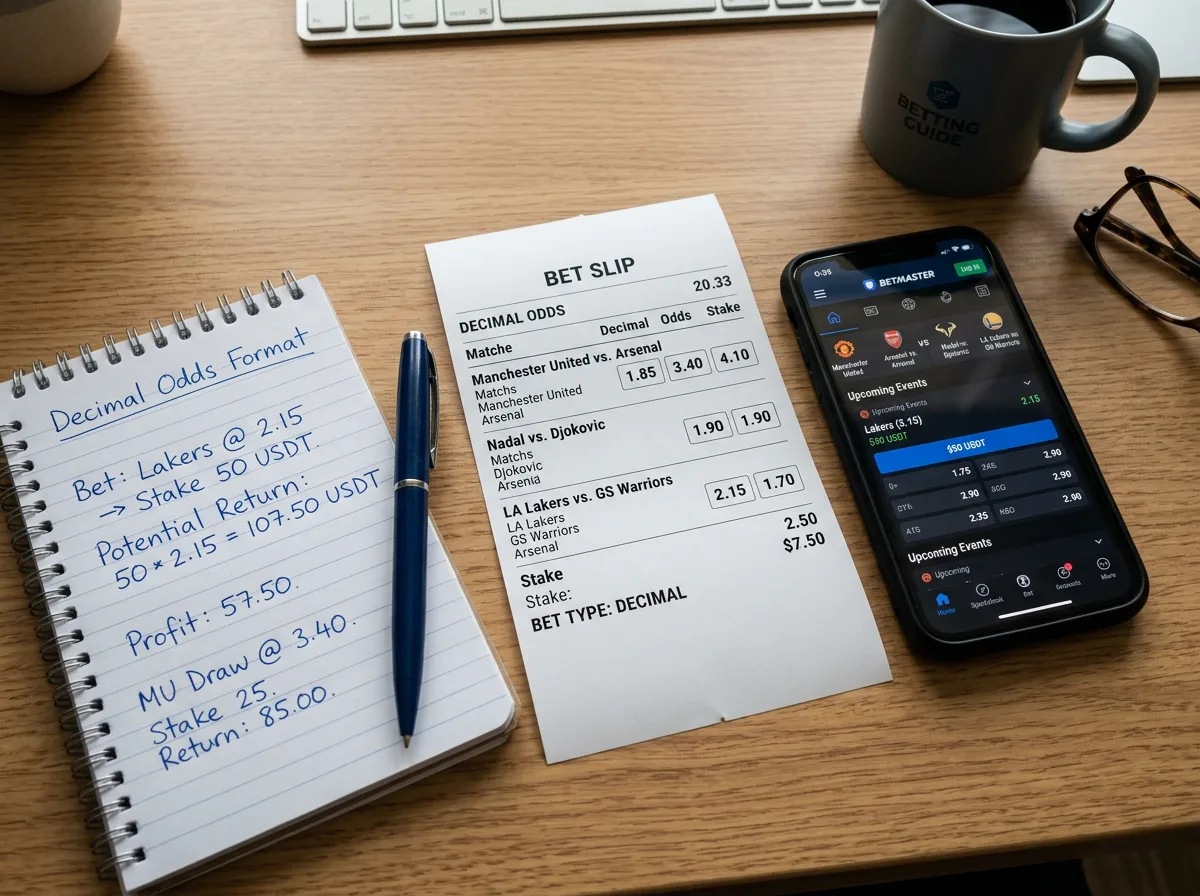
A punter I was advising last year missed out on a profitable bet because he confused American odds of +150 with decimal odds of 1.50 — two numbers that look similar but mean completely different things. He thought he was getting a modest return on a favourite and passed on the bet. He was actually looking at odds that represented a $150 profit on a $100 stake — a value play he would have taken instantly if he had read the number correctly. Odds literacy is not optional in USDT betting; it is foundational.
Australian punters overwhelmingly use decimal odds — it is the standard format at every domestic bookmaker and the most intuitive for calculating payouts. But crypto sportsbooks serve a global audience, and many default to American odds or offer multiple formats that can create confusion if you are not fluent in all three.
Decimal Odds at USDT Sportsbooks
Decimal odds are the native language of Australian sports betting, and with 95.6% of sports bets in Australia placed online, virtually every punter in the country has grown up reading them. At USDT sportsbooks, decimal odds work identically to fiat platforms — the number represents your total return per unit staked, including the stake itself.
A bet of 100 USDT at decimal odds of 2.50 returns 250 USDT if it wins — your original 100 USDT stake plus 150 USDT profit. The calculation is a single multiplication: stake multiplied by odds equals total return. That simplicity is why decimal odds dominate in Australia and across most of Europe and Asia.
The implied probability embedded in decimal odds is equally straightforward: divide 1 by the decimal odds. At 2.50, the implied probability is 1/2.50 = 40%. This means the market prices the outcome as having a 40% chance of occurring. If your own assessment puts the probability higher than 40%, the bet has positive expected value — the fundamental concept underlying every profitable betting strategy.
Most USDT sportsbooks let you set decimal as your default odds format in your account settings. I recommend doing this immediately after registration if the platform defaults to another format. Betting with unfamiliar odds notation introduces unnecessary cognitive friction that leads to miscalculations under time pressure — particularly during live betting.
Converting Between Odds Formats for Tether Bets
Some USDT sportsbooks display only American odds, and a few use fractional odds by default. Converting between formats is simple once you know the formulas, and after a few weeks of practice, you will read all three instinctively.
American to decimal: for positive American odds (e.g. +200), divide by 100 and add 1. So +200 becomes (200/100) + 1 = 3.00 in decimal. For negative American odds (e.g. -150), divide 100 by the absolute value and add 1. So -150 becomes (100/150) + 1 = 1.67 in decimal.
Fractional to decimal: divide the numerator by the denominator and add 1. Odds of 5/2 become (5/2) + 1 = 3.50 in decimal. Odds of 1/4 become (1/4) + 1 = 1.25 in decimal.
Decimal to American: for decimal odds above 2.00, subtract 1 and multiply by 100. So 3.00 becomes (3.00 – 1) x 100 = +200. For decimal odds below 2.00, divide -100 by (decimal – 1). So 1.50 becomes -100 / (1.50 – 1) = -200.
The key insight is that all three formats encode the same information — the relationship between stake and potential return. A bet at 3.00 decimal, +200 American, and 2/1 fractional all mean the same thing: for every 100 USDT staked, you profit 200 USDT if you win. The format is cosmetic; the underlying probability and payout are identical.
I keep a conversion reference on my phone for the first few months when transitioning to a new platform that uses unfamiliar odds. After a while, you develop an intuitive sense for common conversions: +100 = 2.00, +150 = 2.50, -200 = 1.50, -110 = 1.91. Those anchor points make mental conversion fast enough for live betting.
Calculating USDT Payouts From Odds
Payout calculation in USDT follows the same mathematics as fiat — the currency denomination does not change the formula. Australia’s $7.32 billion sports wagering market runs on the same decimal multiplication that your USDT bet uses.
For decimal odds, the calculation is one step: stake x odds = total return. A 75 USDT bet at 1.85 returns 138.75 USDT (75 x 1.85). Your profit is the return minus your stake: 138.75 – 75 = 63.75 USDT.
For multi-bets (accumulators), multiply the decimal odds of each leg together, then multiply by your stake. A three-leg multi at 1.80, 2.10, and 1.55 has combined odds of 1.80 x 2.10 x 1.55 = 5.859. A 50 USDT stake returns 292.95 USDT if all three legs win.
Overround — the margin built into the odds by the sportsbook — is calculated by summing the implied probabilities of all outcomes in a market. For a two-outcome market (win/loss), convert both decimal odds to implied probabilities and add them. If Team A is 1.75 (57.1%) and Team B is 2.20 (45.5%), the overround is 57.1% + 45.5% = 102.6%. The 2.6% above 100% is the sportsbook’s margin. Lower overrounds mean better value for the bettor. I use overround as a primary metric when comparing USDT sportsbooks — a platform consistently offering 103% overrounds delivers meaningfully more value over time than one at 106%.
For bettors wanting to integrate odds analysis into a broader staking framework, the bankroll management guide covers how to use odds and implied probability to size your USDT wagers according to your estimated edge.
Odds Discrepancies Across USDT Platforms
One of the underappreciated advantages of betting with USDT across multiple sportsbooks is the ability to compare odds on the same market without currency conversion. When your bankroll is denominated in USDT at three different platforms, comparing 1.85 at one, 1.90 at another, and 1.88 at a third is a direct apples-to-apples comparison. There is no exchange rate layer distorting the comparison.
Odds discrepancies between USDT sportsbooks are common, particularly on less popular markets. A head-to-head AFL match at a major bookmaker might show identical odds across three platforms. A player prop or a minor league football match can show 5% to 10% differences. Line shopping — checking odds at multiple platforms before placing a bet — is one of the few consistently available edges in sports betting, and USDT’s uniform denomination across platforms makes it frictionless.
The practice takes seconds per bet and adds up over a season. Finding 0.05 better decimal odds on each of 200 bets at an average stake of 50 USDT adds 500 USDT to your returns. That is not edge in the analytical sense — it is simple housekeeping that most punters skip because they cannot be bothered switching between tabs.
Which odds format is most common at USDT sportsbooks?
Decimal odds are the most widely supported format and the default at the majority of crypto sportsbooks. Most platforms also offer American and fractional odds as selectable alternatives in your account settings. Australian punters should set decimal as their default immediately after registration, since it is the standard format in the Australian betting market and the most intuitive for payout calculations.
Do odds at crypto sportsbooks differ from traditional Australian bookmakers?
Yes, and often in the bettor’s favour. USDT sportsbooks typically operate with lower overrounds than Australian-licensed bookmakers, because offshore operators do not pay Australian point-of-consumption taxes. The difference is usually 1% to 2% on the overround, which translates to marginally better odds on the same markets. However, Australian bookmakers tend to update odds faster in response to late team news and market movements, so the pricing advantage is not universal across all timing windows.
The wider context is in the USDT betting guide.
Sizing the bet itself: bankroll management.